
Does Your Location Affect Google Search Results?
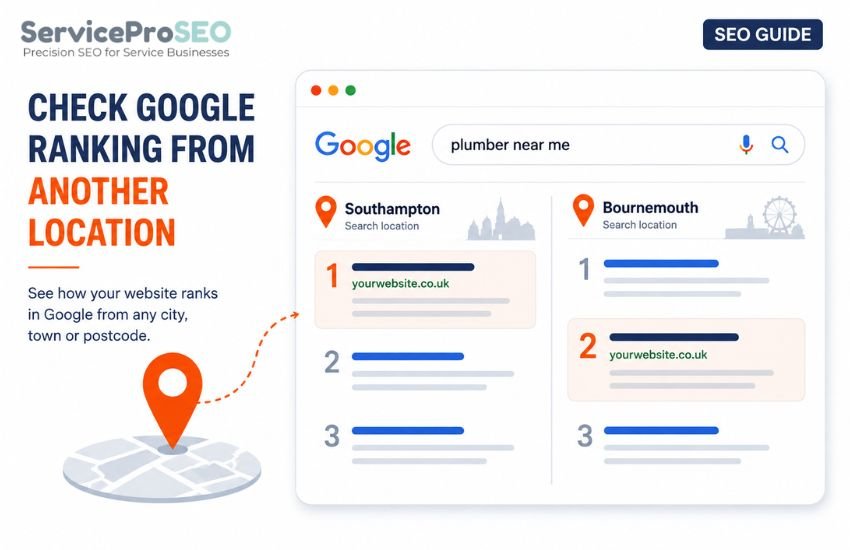
Yes. Search results can differ depending on where a search is made, particularly for queries with local intent. A plumber might rank prominently for “emergency plumber” when the search is made from Southampton, but appear much lower — or not at all — when the same search is made from Winchester, a short distance away.
This isn’t a fault or an inconsistency in how the search was carried out. It reflects how Google uses location and other contextual signals when returning search results. This page looks at why that happens. If you want to check these differences directly, see How to Check Your Google Ranking From Another Location and How to Check Your Google Maps Ranking.
How Google Interprets Local Search Intent
Some searches carry an implicit local intent, even without the word “near me” attached. A search for “emergency plumber” is a good example: most people typing that query want a plumber who can reach them, not the highest-authority plumbing website in the country. Google can use the searcher’s location when interpreting and returning results for a query like this, alongside the words typed.
Other searches carry little or no local intent — a search for “history of the Roman Empire,” for example, isn’t likely to return meaningfully different results depending on where it’s made. The extent to which location shapes a result set depends heavily on whether the query itself has a local dimension.
How Proximity Affects Local Results
For queries with local intent, Google has described its local ranking as weighing factors including relevance, distance and prominence. Distance refers to how close a business is to the location used in the search, or to the searcher’s location where that’s known.
This is one reason the same query can return a different set of businesses in Southampton and Winchester: changing the search location changes the distance between the searcher and potential results, which can contribute to a different set or ordering of businesses.
This page won’t go into how each of these factors is weighted or how to influence them as that’s a broader topic in its own right. The point here is simply that a business’s distance from the search location is one input into why local results vary geographically.
Why Organic Rankings Can Also Vary by Location
Location-based variation isn’t limited to Maps and local pack results. Standard organic results can shift between locations too. This often happens with queries that carry some regional relevance. A “near me” type of search is one example. A country- or region-specific term is another. Sometimes Google infers local intent even when no business listing is involved at all.
A web page written for a specific town or region may rank differently when the same keyword is searched from elsewhere, even though it’s an organic result rather than a Maps result.
This is why checking an organic ranking from a single location may not give you a complete picture when the underlying query has local intent. The position returned from one location isn’t necessarily the position returned from another.
Why Mobile and Desktop Results May Differ
Location isn’t the only part of the search context that can affect the results returned. Google can also return different results for mobile and desktop searches, even when the keyword and location remain the same.
This means two ranking checks using the same keyword and location aren’t necessarily comparable if one uses mobile results and the other uses desktop results. When comparing locations, keep the device type consistent.
Why Your Own Google Search Isn't a Fixed Ranking
There’s no single, universal ranking position for a keyword. A position only makes sense in the context in which it was measured: the query, location, device and point in time. The result set reflects the search context at the moment the search is made, including location and device, rather than a fixed position that applies everywhere.
This is why searching a keyword yourself, from your own device, only shows you one version of the results: the version shaped by your own search context, not a definitive ranking that applies to every searcher.
Check a Google Ranking From Another Location
To understand how a ranking varies geographically, compare the same search across the locations you’re interested in rather than relying on a result from one place.
Keep the keyword, device and search type unchanged and change only the location. This gives you a consistent basis for comparing the results.
The ServiceProSEO Local Rank Checker lets you check Organic or Google Maps results from supported UK and US locations. Your first three checks are free, with no sign-up or subscription required.